
Read Linn County Deed Records by Type
The Register of Deeds enters every instrument that affects land and gives public notice. The deed type signals the transaction's form and the signer's capacity, though the document's own language controls in the end.
| Deed Type | What It Does | Common Use |
|---|---|---|
| Warranty deed | Conveys the described interest with stated covenants | Ordinary arm's-length transfer |
| Quitclaim deed | Conveys whatever interest the grantor has without broad title promises | Family or corrective transfer |
| Executor or trustee deed | Conveys through a fiduciary whose authority must be checked | Estate or trust administration |
| Sheriff or tax deed | Records a transfer arising from a statutory or court process | Enforcement or tax-sale chain |
| Correction deed | Corrects a stated defect in an earlier instrument | Name or description correction |
A deed passes an interest in the parcel. A mortgage, lien, easement, restriction, or release alters the surrounding record without necessarily moving ownership. Pull all of them together by legal description and party name so nothing slips past.
Enter Linn County iCounty
The official iCounty entry shows User ID/email, password, save-user-ID, registration, and password-recovery controls. Registration is free. The public landing page does not display grantor/grantee fields. No stable sample result or online coverage cutoff appears. Check the current subscription choices at the source before deciding how to retrieve an image.
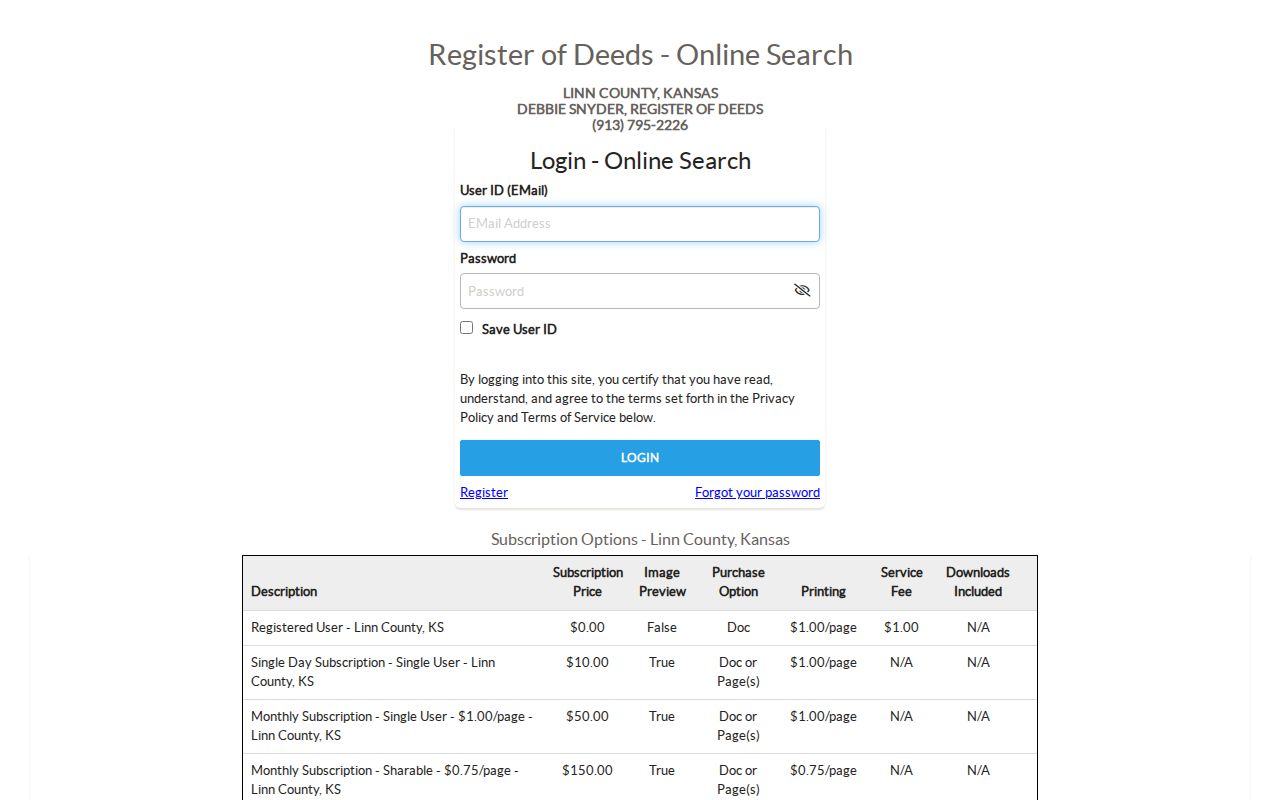
The screen splits free index registration from paid image-preview plans.
Linn County Deed Image Access Costs
| Access | Base price | Image preview | Printing |
|---|---|---|---|
| Registered user | $0 | No | $1 per page plus $1 service fee |
| Single day | $10 | Yes | $1 per page |
| Monthly single user | $50 | Plan access | $1 per page |
| Monthly sharable | $150 | Plan access | $0.75 per page |
| Volume sharable | $250 | Plan access | $0.50 per page |
Portal prices can change. Confirm the live page before you buy. For a certified copy, contact the office and ask for its current copy and certification charge, since no separate certified-copy schedule is published.
Follow Linn County Grantors and Grantees
Start with the current grantee or owner of record, the parcel number, and the full legal description. Keep original spellings and legal capacities exactly as written, and track any normalized forms in a separate note.
- Find the instrument placing title in the current owner, usually with that party as grantee.
- Record instrument number, book/page or image reference, recording and execution dates, deed type, grantor, grantee, and legal description.
- Search the prior grantor as a grantee to identify that party's acquisition deed.
- Repeat until the requested date; when online coverage stops, move to the office or archival index.
- Search forward for mortgages, releases, assignments, easements, restrictions, plats, liens, and corrections.
- Grantor
- The party transferring the described interest.
- Grantee
- The party receiving the described interest.
- Chain of title
- The chronological sequence of instruments affecting ownership.
- Book/page or instrument number
- A locator assigned to the recorded document; retain whichever reference appears.
Linn County Deed Dates and Descriptions
Execution date shows when the parties signed. Recording date shows when the office received and indexed the instrument. The two can differ, sometimes by weeks. Compare the deed's full description against the parcel record, including section-township-range, lot and block, subdivision, exceptions, easements, and attached exhibits.
Lake-community parcels need extra care. A Linn Valley Lakes record may hang on a numbered lot and a recorded plat rather than the casual street label. Search the subdivision name and lot number first. When a description changes, chase the later plats, mergers, boundary adjustments, and corrective deeds that explain it.
Linn's Historical Deed Index Starts in 1857
The Kansas Historical Society finding aid lists a Linn County deed index for 1857–1906. It also covers deed records for 1861–1899. That is an archival backstop, not proof that today's iCounty reaches those years. The landing page publishes no online cutoff. The finding aid also points to probate, court, tax-roll, cemetery, and other county series. Those records can explain a transfer that falls outside an ordinary sale.
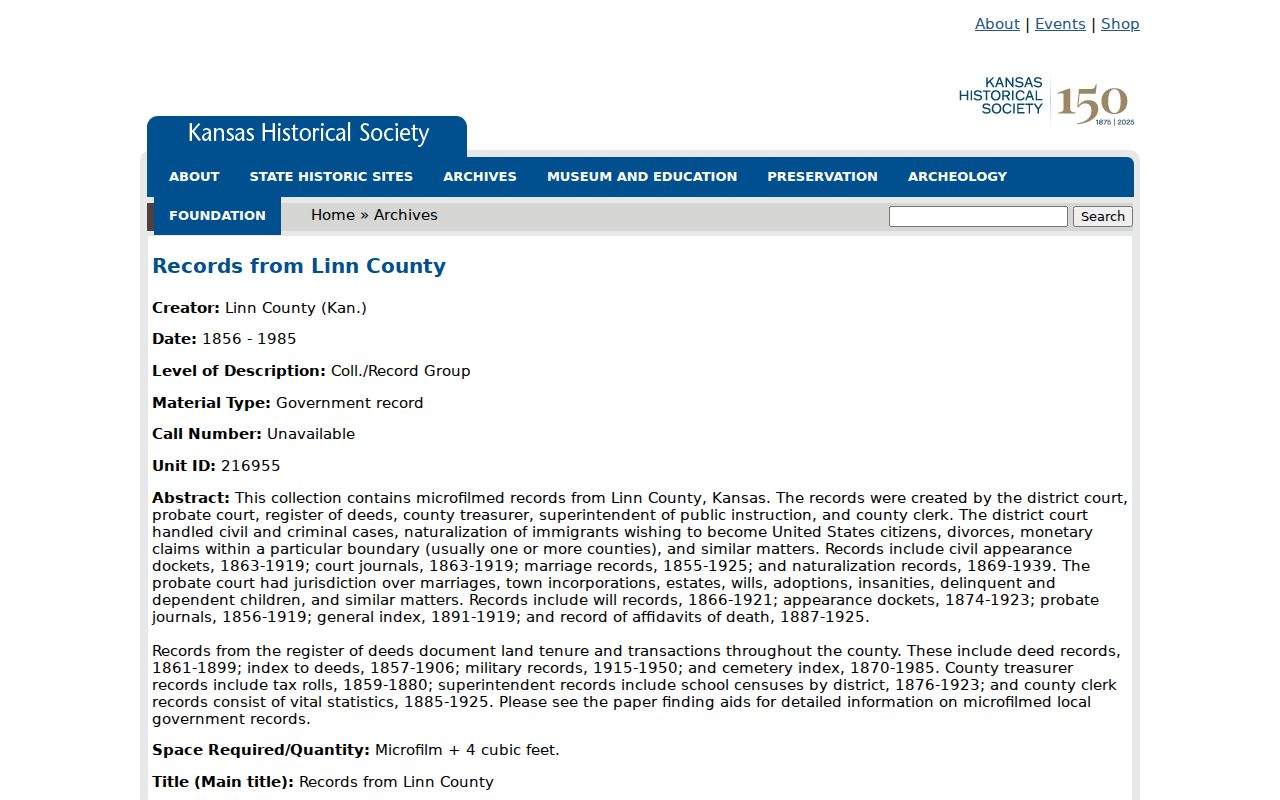
Use the series and date span to request archival or microfilm help. Then tie the historical result back to the current county chain.
Why Early Linn County Deed Records Traveled
KSHS reports that an 1859 election moved the county seat from Paris to Mound City. That December, armed men carried the records out of Paris amid resistance to the move. The lesson is practical. Search period place names and archival series. Don't assume every early entry began at today's courthouse.
For historical digging, pair the deed index with probate records. Do this whenever an executor, administrator, guardian, or heir appears. Court journals matter too. They resolve a sheriff's deed, judgment, partition, or quiet-title clue that interrupts the normal grantor-grantee sequence.
Obtain a Linn County Deed Copy
Use iCounty for the live index and image options. If login, coverage, or image access fails, contact the Linn County Register of Deeds at 315 Main Street, Box 350, Mound City, KS 66056, phone 913-795-2226. Give the office party names, the approximate recording date, and an instrument or book/page reference. Add the document type and complete legal description.
Counter, phone, and written requests all remain valid channels. Ask whether your use needs a plain copy or a certified copy. Confirm the current fee before ordering. A Kansas Open Records Act request can reach existing public records, though a focused office request usually beats it for one known deed.
Recorded, not guaranteed. The Linn County deed index shows instruments accepted for recording; it is not a title opinion, and unrecorded interests or defects may exist.
Linn County Deed Fraud Checks
Linn County publishes no official property-fraud alert signup. Don't substitute a similarly named county or a commercial service. The defensible alternative is periodic comparison of your own record. Match the parcel and tax IDs against the tax roll. Check the latest deed's parties and legal description. Inspect the recording references. Watch for corrective deeds or releases. If an instrument looks inconsistent, preserve its reference and call the Register of Deeds. An unfamiliar owner label may just reflect a recent deed, entity, trust, estate, or timing difference. Title-critical conflicts belong with a qualified attorney or title professional.
Request Related Linn Instruments Together
One deed rarely settles a title question by itself. For a current purchase, gather the latest deed and prior deed together. Add the mortgage and release search, plat, and easements. Estate transfers need more. Pull the probate index and the journal or will reference that supports the signer's capacity. For a sheriff or tax instrument, tie the recorded deed to the court action, sale status, and later releases, since a notice or sale list is not the completed transfer.
A compact chain table keeps every step visible. List sequence, recording date, execution date, instrument number, book/page or image, grantor, grantee, capacity, instrument type, legal description, prior reference, and next action. Keep misspellings exactly as indexed. Note the normalized names separately. Gaps then stand out, whether an assignment lacks its release, an estate deed lacks its authority trail, or a plat reference was never retrieved.
Forward searching matters as much as the backward ownership sequence. For each owner, search mortgages, assignments, and releases as separate instruments. Then hunt for judgment liens, mechanic's liens, lis pendens, easements, and restrictions. Search plats, boundary adjustments, mergers, corrections, and powers of attorney as well. Link each release to the instrument it satisfies. Never assume an old mortgage vanished when title transferred.
Capacity words often explain an apparent break. An executor, administrator, or personal representative should point toward probate authority. A sheriff or court-directed conveyance should lead to the underlying Linn County case. A trustee's capacity stated in the instrument deserves care. A Kansas business-entity search can confirm an entity's exact filed name and status. It cannot establish that entity's land ownership without the recorded deed.
Match deed to plat for lot-and-block tracts. Check later amendments too. For rural acreage, preserve section, township, range, exceptions, and attached exhibits. Addresses are only finding clues. A deed may describe a parent tract. The parcel card may show a later split. Follow the plat, survey, lot-split, merger, or corrective instruments that created the modern record key.
Archival work needs the same split between index and document. The KSHS deed index establishes a searchable historical series with dates. The deed book supplies the instrument text. Probate journals, tax rolls, and court records can explain historical possession or authority. None of them proves the present chain alone. Bring historical legal descriptions forward carefully, since road names, place names, and parcel identifiers change.
State plainly whether you need a plain image or a certified copy when ordering. Confirm the fee first. Give the office enough detail to isolate one instrument. Include party names, recording period, document type, instrument or book/page reference, and complete legal description. That focused request helps in another way. It lets the recorder say whether the date falls outside iCounty's current online coverage.