
Inside Linn County Property Tax Records
Two files work together in any Linn County tax review. The Linn County Appraiser builds the valuation and classification record first. The County Clerk then applies certified levies to it. From there the Treasurer handles billing and collection. The Treasurer also reports on payment or delinquency. Keeping those stages separate matters. It stops an old tax figure from being read as a current appraisal.
| Record item | Meaning | Official source |
|---|---|---|
| Appraised value | County valuation under the Kansas framework for the stated year | Appraiser parcel file |
| Class and assessed value | Actual-use classification and the taxable percentage of appraised value | Appraiser and certified roll |
| Taxing entities and mills | The school, township, city, county, or other units applied to the account | Clerk certification and Treasurer result |
| Bill and amount paid | Tax charged and payments posted for a selected year | Treasurer tax search |
| DLQ status | Whether the result carries a delinquency indicator | Treasurer tax search |
A tax bill is not a sale-price statement. The account name is not proof of title either. For real ownership evidence, compare the legal description with the latest recorded deed using the deed-records guide.
Search Linn County Taxes by ID, Year, or Street
The official Linn County Treasurer tax search is the direct online channel for the county. An August 2025 operational report documented account access back to 2020 and confirmed the database covers all taxpayers, not just delinquent ones. Its field choices handle exact parcel-number work and broader address or name attempts alike.
| Search input | Best use | Handling tip |
|---|---|---|
| Tax ID | Matching a known parcel account | Copy punctuation and leading zeroes exactly |
| Tax year | Keeping bills and assessed values in the proper period | Repeat the lookup for every relevant year |
| Address or street | Finding an account when the ID is unknown | Try versions without directionals or street-type abbreviations |
| Last name or company | Recovering an account under the taxpayer label | Try punctuation and legal-name variants |
The Treasurer's search page displays these entry fields in the county interface. Open the tax search portal itself before counting on the layout, since portal controls can change.
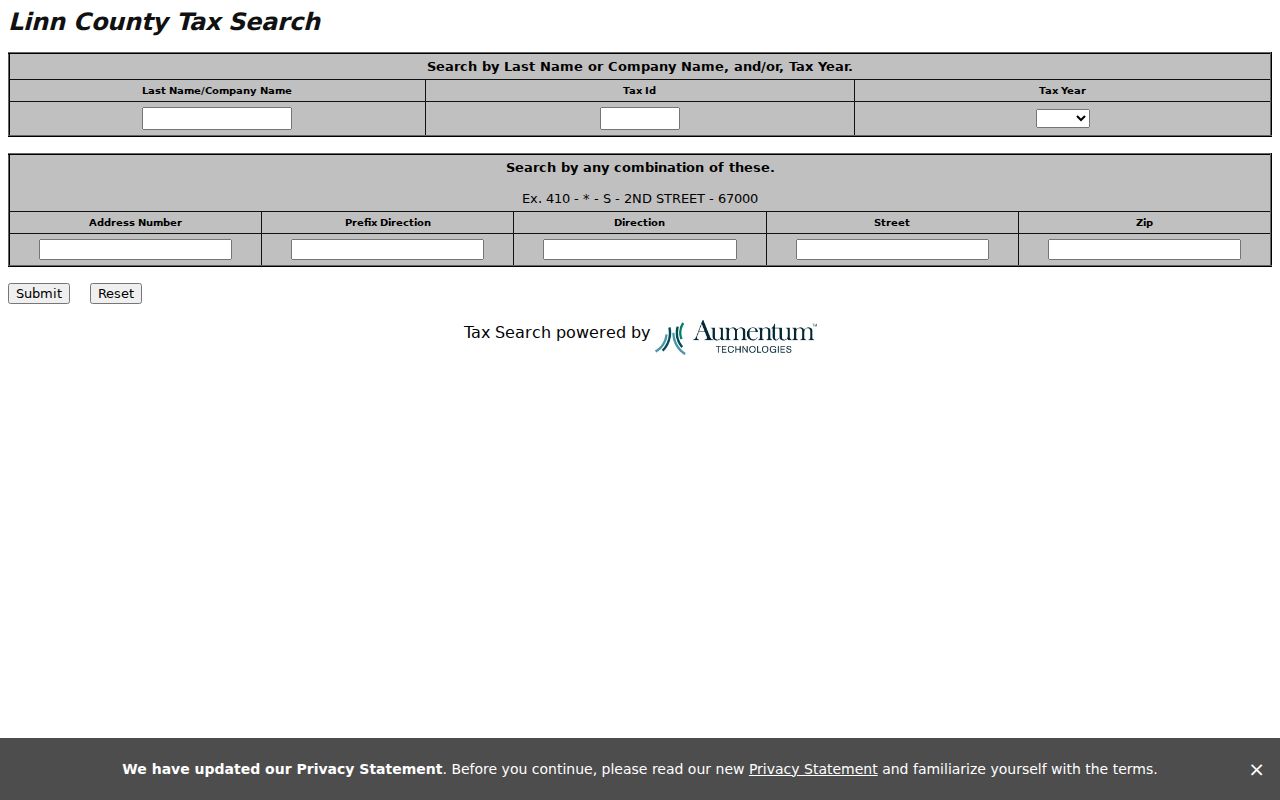
Treat the search screen as a field guide. Identify the account first. Choose the year deliberately. Then preserve the result date alongside the bill information so the tax evidence carries its own timestamp.
Note: A search screen proves an access route, while the Treasurer's dated account result supplies the tax evidence.
Retrieve a Linn County Tax Bill in Four Checks
Reach for the parcel identifier first. It is more stable than a rural mailing label or a lake-community street description, which can shift or repeat across systems.
- Open the Treasurer search, enter the tax ID, select the needed year, and save the exact query used.
- Record the legal description, taxing entities, assessed valuation, tax bill, amount paid, and the separate DLQ flag.
- Open the public Linn County parcel search and compare parcel identity, classification, valuation year, and legal description.
- If payment, redemption, sale, or penalty remains unclear, call the Treasurer at 913-795-2227 or make a parcel-specific request.
- Appraised value
- The county valuation figure before a statutory assessment percentage is applied.
- Assessed value
- The taxable figure produced by applying the rate for the property's actual-use class.
- Mill levy
- The rate applied to assessed value; one mill represents one dollar per $1,000.
- Tax lien
- A claim arising from unpaid property tax; current status requires Treasurer and recorded-record confirmation.
When the online form fails, contact the Treasurer. Provide the parcel or tax ID, owner or company label, situs, complete legal description, desired years, and a precise question. Ask about available formats and any copying charge rather than requesting an unrestricted taxpayer list.
Why a Paid Linn Account May Still Read DLQ
The county's 2025 portal description carries an unusually useful warning. A record can show a paid amount equal to the bill. It may still display DLQ: Yes because payment arrived late. Conversely, DLQ: No means the account carries no delinquency flag in that result. The dollar column and the status column answer different questions.
Ask the Treasurer whether the issue is current balance, penalty, redemption, distribution, or tax-sale status. A saved result is only a dated snapshot. A later payment, redemption, court event, or recorded instrument can change the conclusion. An older screenshot sits still.
Read every status field. Never infer that a parcel is currently delinquent, redeemed, or sold from a bill amount or an old sale list alone.
From Linn Appraisal to Assessed Value to Tax
Kansas Department of Revenue guidance lays out the arithmetic. Appraised value multiplied by the assessment rate yields assessed value. Assessed value multiplied by mills, divided by 1,000, estimates the tax. Classification drives the rate. Residential property is generally assessed at 11.5 percent. Vacant lots sit at 12 percent. Commercial property is assessed at 25 percent. Agricultural land is set at 30 percent of use value, and agricultural improvements at 25 percent, all subject to current law and the parcel's actual use.
Classification follows actual use, not the color on a zoning map. A residential-looking tract, a vacant lake lot, agricultural acreage, and commercial improvements can therefore land in different assessed-value relationships. Exemptions, special assessments, and partial-year changes can push an actual bill away from any simple calculation. The particular taxing units matter too.
Note: Put a year and an exact label beside every value; an assessed value is neither a sale price nor a market offer.
The Linn County Roll Moves Through Three Offices
Three offices move the Linn County roll. The Appraiser handles annual discovery, inspection, market study, and valuation. The Clerk calculates assessed valuation and mill levies and certifies the roll. The Treasurer mails bills, accepts payment, and distributes collections. Because of that handoff, a value dispute, a levy question, and a payment question each belong with a different custodian. All three still appear in one property-tax story.
| Question | Start here | Record to preserve |
|---|---|---|
| Condition, class, acreage, or appraisal | Appraiser | Valuation notice and parcel card |
| Taxing units or certified levy | County Clerk | Certified roll and levy detail |
| Bill, payment, DLQ, redemption, or sale | Treasurer | Dated tax result and office response |
A recent deed may reach the Register of Deeds well before any annual valuation update appears. Linn County publishes no numeric roll-lag interval. Compare recording date, valuation year, and tax year instead of assuming every screen updates together.
A Linn County Tax-Sale List Is Not a Deed
A local report described more than 120 past-due-tax properties. The sale was held on August 22, 2025. That is useful historical evidence of enforcement. It proves no present owner and no current redemption outcome. Confirm the parcel's later status with the Treasurer. Check any applicable court proceedings. Search the Register of Deeds for a resulting sheriff deed, tax-sale, redemption, release, or later conveyance instrument.
For a defensible year-by-year review, give each data point its own column. Track the tax ID, legal description, assessed valuation, and taxing entities. Add the bill, paid amount, and DLQ status as well. Parcel splits, mergers, and annexations can change identifiers and taxing units. So an address-only comparison can quietly join two different accounts.
Choose the Correct Linn County Assessment Appeal
Linn County taxpayers have two ways to contest a valuation. The Kansas appeal guidance explains both. One route challenges the spring valuation notice through equalization. The other protests the tax at payment time. A taxpayer cannot generally pursue both routes against the same year's value. Hold onto the notice itself. Its date and instructions set the parcel-specific deadline that governs any appeal of Linn County property records.
The statewide calendar gives a rough shape to the year. Valuation notices for real property usually go out around March 1. Most taxpayers get about 30 days to open an equalization appeal. Informal meetings generally wrap up by May 15. Determinations come near May 20, with certification around June 1. The Clerk certifies the tax roll on November 1. Statements are mailed near December 1. First or full payment is generally due December 20. The second half is due May 10. Confirm each date for the current year before relying on it.
Appeal window. Contact the Linn County Appraiser promptly after the notice; use photographs, measurements, condition facts, comparable sales, class, and actual-use evidence tied to the same valuation year.
Build Evidence Around the Linn Parcel, Not a Guess
Evidence beats opinion in an appeal. Build the packet around the parcel itself. Include the parcel number, legal description, valuation notice, classification, and improvement details. Add dated photographs. Comparables only carry weight when class, size, condition, location, use, and valuation year genuinely align, because a neighboring assessment without those controls proves little about your parcel's value in the Linn County tax roll.
Ask why the number changed. Was it annual review, a new improvement, or reclassification? Was it an exemption, a parcel split or merger, or a correction? Kansas lists numerous statutory exemptions, and agricultural land is valued under use-value rules. Confirm eligibility and the relevant tax year directly rather than assuming it from a statewide summary.
Request Linn Tax Records When Online Access Stops
Online access is not the only door. When a Linn County property search stalls, the Kansas Open Records Act procedure in K.S.A. 45-220 gives you a formal path. Direct the request to the office that holds the record, and name an identifiable account, record type, and date range. The agency may require requester information, a use certification, reasonable copying costs, and review or redaction fees. Ask for a cost estimate first when the request is large.
K.S.A. 45-230 places limits on solicitation using public name-and-address lists. Keep the request anchored to a defined parcel question. Do not redistribute bulk owner-of-record or address results. If the custodian cannot supply a record, ask which restriction applies and what lawful format is available instead.
Note: Online access, a counter request, a phone inquiry, and a written KORA request all work together as channels for Linn County property tax records.