
Compare the Values Attached to a Linn County Parcel
A sound Linn County property value comparison begins with labels. Preserve each number's exact source, year, and name. The county parcel file exists for valuation, a deed documents a transfer, and the Treasurer carries prior-year tax information. Similar-looking figures can therefore run on different clocks.
| Value type | What the figure means | Where to verify it |
|---|---|---|
| Appraised value | The county's valuation figure under the Kansas mass-appraisal framework | Linn County Appraiser parcel file and notice |
| Assessed value | The taxable percentage of appraised value based on actual-use classification | Appraiser record and certified roll |
| Recorded sale evidence | Consideration or transfer details, if shown and properly interpreted | Recorded deed or related transfer instrument |
| Current market estimate | An opinion of likely value under a defined date and purpose | Qualified appraisal or careful market analysis |
| Tax amount | Assessed value subjected to applicable mills, units, and adjustments | Treasurer tax account |
A tax amount is not a property value. A sale price is not automatically current market value either. That distinction sits at the center of this comparison, while bill and payment mechanics appear separately in Linn County property tax records.
Locate a Linn County Property Value by Parcel
The Linn County Appraiser links the official public parcel search. The legacy portal offers a public unregistered entry alongside a registered login, and it requires acceptance of a disclaimer before use.
- Start with a known address or parcel ID and use the public parcel-search route.
- Save the parcel ID, situs, legal description, classification or type, acreage, improvements, displayed value labels, and valuation year.
- Open the ORKA map to confirm that the shape, road, lot, and subdivision context match the intended land.
- When sale evidence matters, use the latest recorded instrument rather than inferring a price from assessed value.
The static public view stops short. It does not expose the complete record form or a dependable sale-price field. Describe only fields actually visible in a live result, and never borrow labels from another county that runs similar software.
Why Linn County Displays Different Data Years
The parcel disclaimer draws a sharp line. Appraised values are current-year information, while tax information reflects a prior assessed value. That warning explains the mismatch. A parcel page and a tax account can both be official yet show different years. Open the public-use and data-currency notice before entering the assessor system.
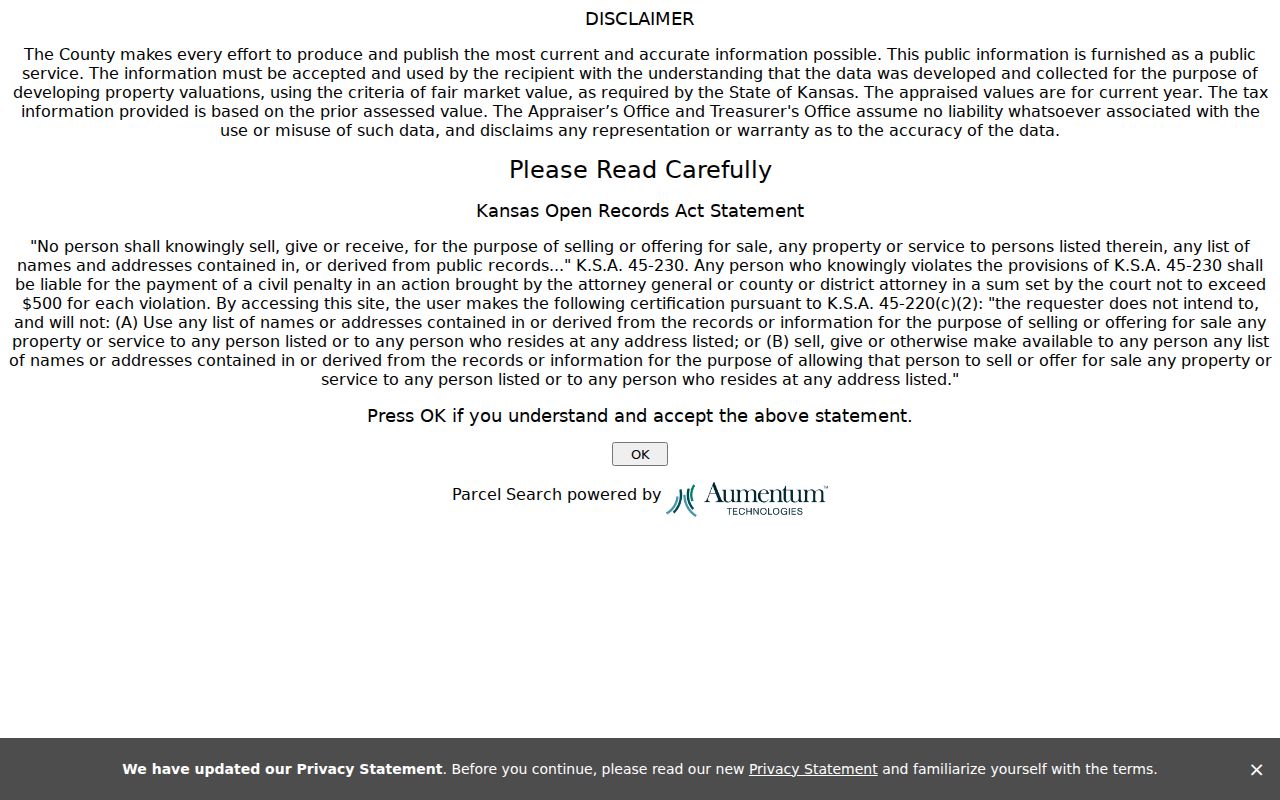
The notice makes the timing distinction explicit. It also repeats Kansas restrictions on repackaging certain public name-and-address lists. Note: Copy the year beside every value rather than trusting the newest-looking page to hold the newest figure in every field.
Actual Use Shapes Linn County Assessed Value
Kansas Department of Revenue guidance lays out the sequence plainly. Multiply appraised value by an assessment rate to reach assessed value. Residential property is generally assessed at 11.5 percent of appraised value. Vacant lots sit at 12 percent. Commercial property sits at 25 percent. Agricultural land carries 30 percent of use value. Agricultural improvements carry 25 percent, subject to current law.
Actual use controls classification, not a zoning-map label alone. This matters in Linn County. A vacant lake lot, an improved residence, agricultural acreage, and commercial land can sit near one another. Compare class, improvement type, acreage, and valuation year. Do this before calling any parcel a valid value comparison.
- Appraised value
- The county's valuation estimate under the statutory framework.
- Assessed value
- The appraised figure after the applicable class percentage.
- Actual-use class
- The legally relevant category for assessment, which can differ from zoning.
- Valuation year
- The period to which the county figure applies.
The Linn County Valuation Clock Runs Annually
Linn County handles its appraisal work annually. Its parts include discovery and inspection. Sales analysis, market studies, and statistics round out the process. State calendar guidance places real-property valuation notices around March 1. Equalization follows, with certification around May and June. The Clerk later certifies the tax roll, and the Treasurer bills from it.
The county publishes no numeric deed-to-parcel-card refresh lag. A recent transfer can appear in deed records first. The owner label or valuation-year display may lag behind it. Compare the deed recording date, appraisal year, tax year, and any permit or improvement date rather than trusting one screen silently.
| Clock | Date or period to save | Why it may differ |
|---|---|---|
| Recorded transfer | Execution and recording dates | The deed can precede administrative updates |
| Appraisal | Valuation year and notice date | Annual review and certification cycle |
| Tax | Tax year | Tax fields may use a prior assessed value |
| Improvement | Permit, inspection, and completion dates | Construction and appraisal updates are separate events |
Use Recorded Linn Sale Evidence Carefully
The assessor portal presents no dependable sale-price field. If a live parcel result shows a sale amount or date, keep its field label and source year. Otherwise review the deed image or transfer instrument. Use the Linn County Register of Deeds iCounty portal. Consideration may be omitted, nominal, or shaped by the transfer type.
Each type can carry a different valuation meaning. That includes a warranty deed, quitclaim deed, trustee or executor deed, related-party transfer, correction, partial-interest transfer, or sale involving personal property. Match the full legal description first. Determine what interest actually changed before treating a number as a comparable sale. Note: Recorded consideration can evidence a transaction. It is not a certified opinion of current property value.
Build a Linn County Classification Audit First
Build a short audit before assembling comparable sales. List actual use, zoning, improvement type, and acreage. Also list valuation year, assessment rate, taxing units, and any exemption. This catches a common mistake. Owners sometimes compare a residence with vacant or agricultural land just because the parcels sit close on the map.
Next, compare physical characteristics and condition documented in county records, permits, and photographs. A professional inspection can help when relevant. The Appraiser's annual field review can update observed characteristics even without a deed transfer. A recent purchase price can inform analysis too. It does not automatically dictate the county assessment, though.
Explain a Linn Value Change Before Calculating It
Explain a shift before calculating it. A change may reflect annual market review. It may also stem from a new improvement, corrected acreage, reclassification, or an exemption. A parcel split or merger can be the cause. So can a simple data correction. Keep appraised value, assessed value, tax amount, and amount paid in separate year-by-year columns. A percentage change in assessed value is not the same as a change in market conditions. The two can move at different rates.
Suppose the displayed assessed value misses the expected class percentage. Check actual use first. Then check agricultural use-value rules, exemptions, and the data year. The screen may be showing prior-year tax information. Ask the Appraiser which field controls rather than "correcting" the record with a guessed rate.
What Linn County Assessor Value Does Not Promise
The Linn County assessor's number comes from mass appraisal. That method is built to spread the tax burden fairly across all parcels. That is its whole job. It is not a boundary survey, a structural inspection, or a title opinion. Nor does it promise permit compliance. It does not predict what any particular buyer will pay for a Linn County property, since market conditions and property-specific facts can shift after the valuation date.
Value is not price. For a transaction-sensitive present-value opinion, use a qualified appraiser and provide the correct parcel, legal description, effective date, and purpose.
Challenge a Linn County Value with Year-Matched Evidence
Kansas appeal guidance draws a clear line. It separates the spring equalization appeal from payment under protest. The notice date controls. A taxpayer generally picks one route. Both cannot be used for the same year's value in Linn County. Preserve the notice envelope, and contact the Appraiser promptly to protect your options.
Build a focused packet before filing. It should include the parcel ID, legal description, class, and the official notice. Add photographs, measurements, and condition facts. Include comparable sales, permit or repair chronology, the prior valuation, and the correction you want. Every comparable should match the valuation year. Test each one for use, size, condition, location, and improvements.
Request a Linn Valuation Record Beyond the Portal
The online parcel portal is not the only route. The Appraiser will take a parcel-specific question by phone. The Appraiser can also take one in person at the Mound City county campus. A written request that identifies the requester can also be made under K.S.A. 45-220. It should list the parcel ID, legal description, situs, record type, and valuation years. It helps to ask up front about format options, redaction, staff time, and copying charges.
One caution comes from K.S.A. 45-230, which limits how public name-and-address lists may be used. Tie any request to buying or selling due diligence, a valuation review, or an estate. A defined boundary issue or civic research also works. Do not republish a bulk owner list. If value, deed, GIS, and tax records ever disagree, keep each source and its date. The responsible office can then explain the difference.