
Build a Backward Timeline of Linn County Former Owners
Start your timeline with the newest deed that applies to the Linn County parcel. That instrument names the owner of record who acquired it. Their name becomes your next grantor. Work from each transfer backward to the earlier one. Continue until you cover the period you need. Keep the legal description constant throughout. That way, every instrument you log clearly concerns the same Linn County land. One row documents one transfer, not a sample transaction.
| Transfer date | Grantor → grantee | Deed type | Book/page or instrument |
|---|---|---|---|
| Newest recorded transfer | Prior owner → current grantee | Copy exact instrument label | Save both index and image reference |
| Previous acquisition | Earlier owner → prior owner | Warranty, quitclaim or other recorded type | Match legal description before continuing |
| Earlier book era | Repeat grantee-to-grantor link | Retain historical terminology | Use deed book and page |
| Archival endpoint | Last documented prior owner | Record any probate/court capacity | Cite series and call number |
Keep execution and recording dates apart in your notes. Copy the lot and block, subdivision, section-township-range, exceptions, and prior references as well. A shared surname proves nothing about a link between former owners. The land description has to match.
Start the Linn County Deed Trail at iCounty
The Register of Deeds iCounty portal is Linn County's online entry point for deed records. It also covers mortgages, releases, plats, easements, and liens. Its public page presents login, registration, and subscription choices. The full grantor-grantee form and any published online cutoff are not shown there. Registration carries no subscription charge, though image preview is unavailable at that tier. Printing costs $1 per page plus a $1 service fee. A one-day option runs $10 and includes preview plus $1-per-page printing. Monthly tiers are also listed. The official page establishes the access and fee gate. It does not show which years or fields a signed-in property search will expose. Visit the Register of Deeds iCounty portal to begin.
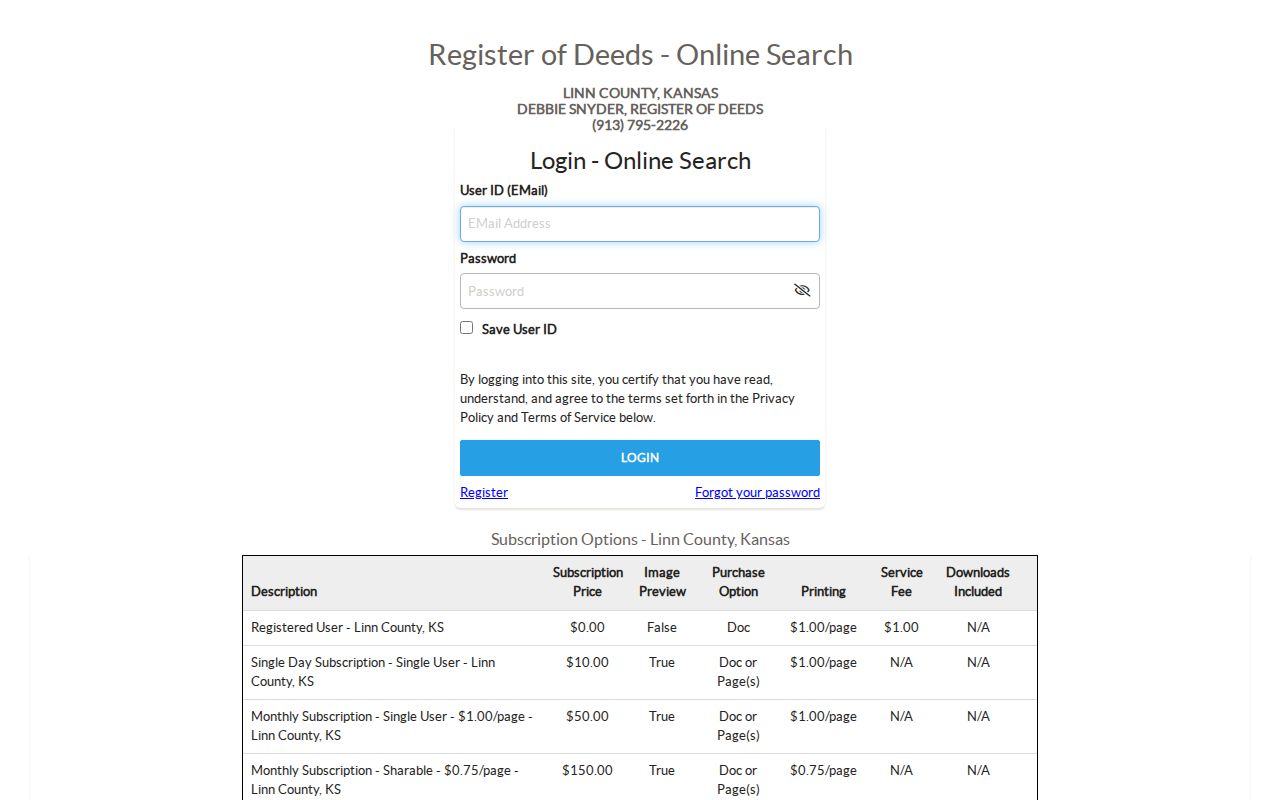
Register for the live search when details matter. A historical interval, an image rule, or an index boundary can decide whether the online route works. The Register of Deeds can answer those questions directly. Do not invent an online starting year from the archival dates.
Walk the Linn County Deed Chain in Reverse
The current deed gives you the grantor's name. Use that name to launch the next backward search in the Linn County deed records. Track the land and each party's capacity together, and note spelling variants and negative searches honestly rather than forcing one continuous story.
- Use the current parcel ID and legal description to find the deed that placed title with the latest grantee.
- Read the grantor from that instrument and search that name as an earlier grantee.
- Compare every legal description, prior reference and capacity; search variants created by marriage, estates or entity changes.
- Repeat through iCounty as far as verified, then move to the Register’s deed books or the KSHS archival series for older former owners.
- Grantor / grantee
- The conveying party and receiving party named in an instrument.
- Chain of title
- The ordered sequence of instruments affecting the same legal interest.
- Reverse index
- A grantor/grantee finding method used to step backward from a known owner.
- Warranty vs quitclaim
- Different deed forms; neither label alone proves the chain is complete.
KSHS Extends Linn County Ownership Research Into the 1800s
The Kansas Historical Society Linn County finding aid identifies a deed index covering 1857 through 1906. It also identifies deed records for 1861 through 1899. Treasurer tax rolls run from 1859 to 1880. The finding aid also lists probate and district-court series, which can explain transfers that fall outside an ordinary sale, such as an estate settlement or a court-ordered conveyance. Those dates describe the archival holdings only. They are not the cutoff for the current iCounty database.
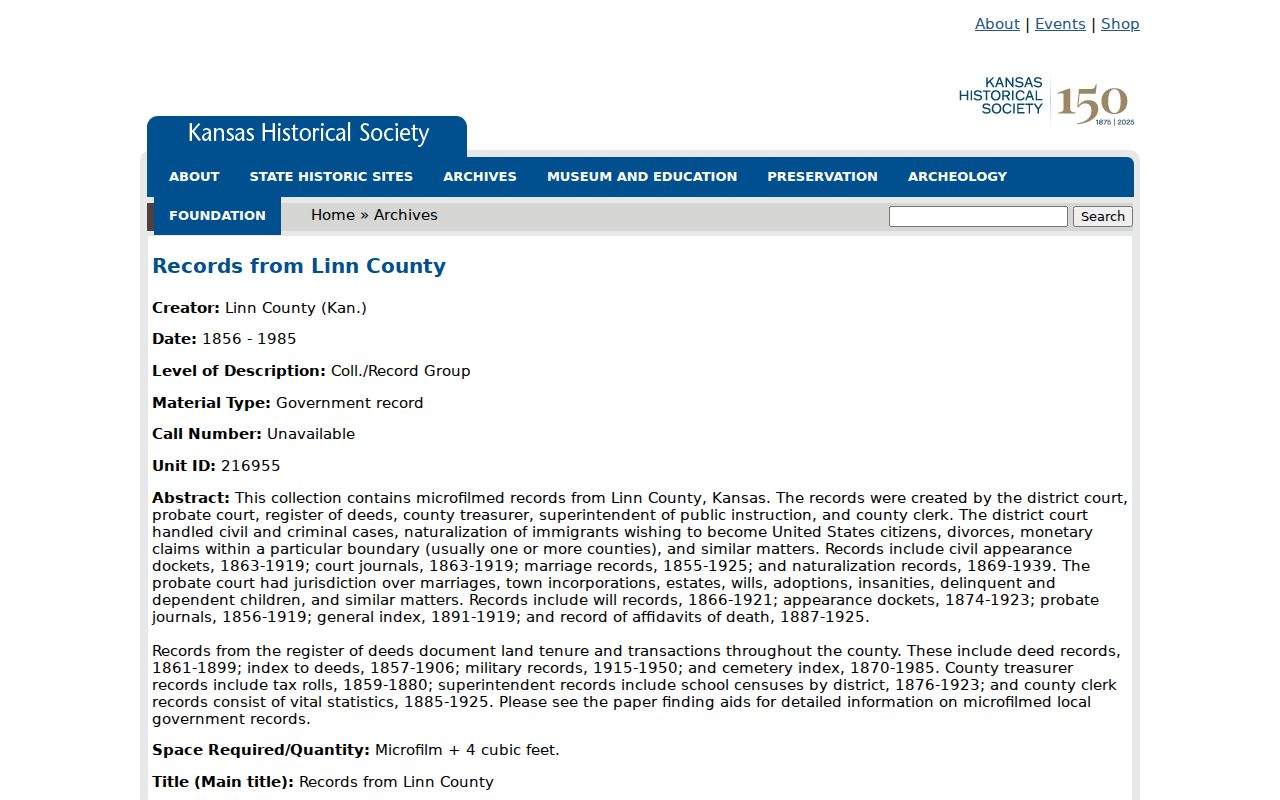
Request the relevant series or microfilm using its date span and call number. Return to Linn County's current property records for any present-day title conclusion.
Probate and Court Records Can Repair a Broken Linn Chain
A sheriff, trustee, executor, administrator, or personal representative named on a deed is a signal. It points to authority held in another record series. Pull the referenced case or estate first. Then obtain the probate order or court document that explains the transfer. The Kansas court portal offers eligible public case and event-index information. Rule 22 limits remote access to some documents. The Linn County courthouse terminal and the Clerk of District Court remain important alternatives.
Never infer an heir or former owner from genealogy alone. Historical marriage, vital, and cemetery sources can connect name variants and suggest leads. The deed, the probate order, and the legal description remain the actual property evidence. Keep identity leads labeled separately from confirmed transfers.
From Paris to Mound City: Follow Linn County’s Old Record Geography
Linn County's seat moved from Paris to Mound City after an 1859 election. KSHS reports that armed men removed the records from Paris in December 1859. The removal happened amid resistance to the move. That upheaval explains the odd geography of early searches. You may hit older place language or custody assumptions that don't match today's courthouse route. Modern street addresses make weak keys for nineteenth-century records anyway. Crosswalk the current parcel to its township, section-range, recorded subdivision or lot first. Treat names like Mine Creek, Trading Post or Moneka as clues, not conclusions. The legal description is the bridge across every changing name.
Search the Negative Space After Each Linn County Transfer
After each deed, search the prior grantor. After each mortgage, hunt the release or assignment on its own. After a plat, check later amendments, lot splits and mergers. After a probate deed, find the probate index and final order. One positive instrument rarely tells the whole story of previous owners or their interests. Keep a negative-search log listing the portal, date, access level, exact spelling, legal-description variant and date range. Record the result count, image availability and next source. A missing iCounty result can reflect an unknown coverage boundary, a spelling variant or a larger parent tract. It can also point to an estate transfer. It is not proof that no deed ever existed.
How Far Back Linn County Former-Owner Records Reach
The archival deed index begins in 1857. The KSHS deed-record series starts in 1861. No stable starting year is published for iCounty, so no honest page can claim the modern index reaches that far back. For missing years, ask the Register of Deeds about the deed book, index coverage and image availability. Ask KSHS about microfilm using the identified series. Then make your stopping point explicit. Name the last confirmed instrument, the last matching legal description, the repositories you used and the gap that remains. A house-history or estate trail built that way stays reproducible. It never pretends to be a title opinion.
Coverage limit. The historical Linn County deed index begins in 1857, but the current online cutoff was not published; older former owners may require deed books or KSHS microfilm.
Linn County former-owner records serve three purposes. They support property history work, estate matters, and transaction diligence. The same records must never be used to track, harass, or harm a living person.
Preserve Linn County Previous Owners as a Research Packet
Build a research packet for every former owner. Record the name exactly as spelled in the deed. Keep any normalized form in a separate note. Capture the grantor and grantee capacity. Capture the execution and recording dates, instrument number, and book/page or image reference. The deed type, full legal description, and prior reference belong in the packet too. A next-action column can flag mortgage, release, easement, plat, or correction leads. This discipline keeps one person's name from becoming the only link between two tracts.
Add the current parcel map and legal description. Include the relevant KSHS series or deed-book citation. Probate or court papers matter only when they explain a transfer. Flag images you could not open. Flag online years that remain unclear and name variants that failed. A finished Linn County ownership history should name the last confirmed prior owner. It should also cite the exact source for reaching farther back.
Historical tax rolls can corroborate a name in a given year. Still, they are administrative evidence. A plat can explain how a subdivision began without proving every later title interest. Keep these source roles distinct. That discipline makes the timeline useful to a historian, heir, purchaser, or title professional.