
Read the Linn County Current-Owner Record Card
The Appraiser's parcel record answers the who-owns-now question in one place. Always match the parcel first, not just the surname. The situs, parcel number, and legal description keep two similar owners or road names from collapsing into one property. The portal's static entry page does not show the live form labels. Use the official ORKA schema instead. It confirms the ownership and parcel concepts that matter here.
| Owner Name | The roll’s present owner/current-owner label; copy spelling and capacity exactly |
|---|---|
| Mailing Address | Mail1–Mail3 lines used for owner correspondence, not proof of residence |
| Situs | The property location used to match the parcel |
| Legal Description | Lot, block, subdivision or section-township-range clue for deed comparison |
| Book/Page | A displayed deed reference that can lead into recorded instruments |
| Parcel Identity | The stable key to carry through GIS, appraisal and tax records |
Treat the owner mailing line as a contact clue only. It may be a post office box, an out-of-county address, a fiduciary, or an entity's office. The situs identifies the land itself. Neither line proves who is physically present on the property.
Check Who Owns Now Through Linn County’s Public Entry
The Linn County Parcel Search offers a public, unregistered option. You just pass its entry screen and disclaimer. Enter an address or parcel identifier the live form accepts. Then record the owner label, mailing lines, situs, legal description, and valuation year from the result. If the address search fails, find the shape in ORKA. Carry that parcel ID back to the Appraiser's parcel search. The county's official access screen is where every current-owner check begins. It is a gateway, not a returned parcel record. So expect a disclaimer rather than owner data on that first page.
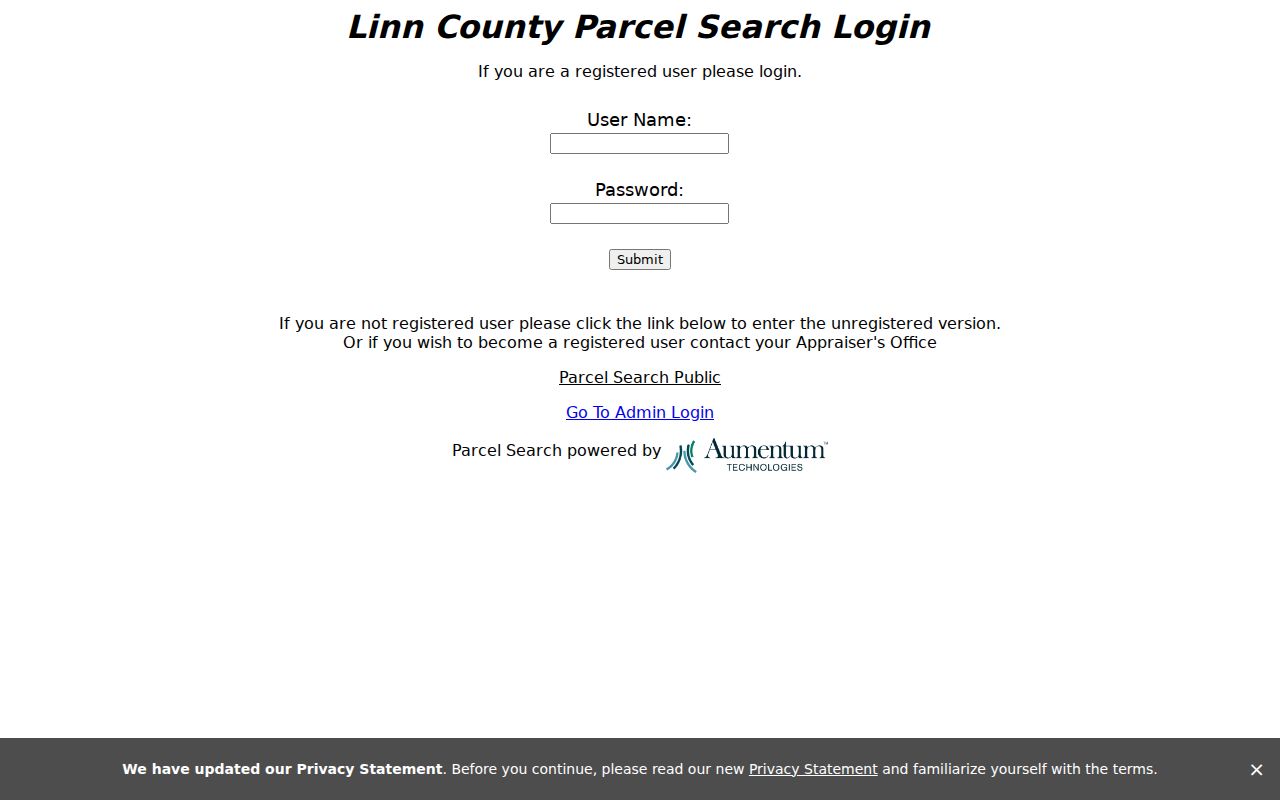
Choose the public parcel-search link and note the date you checked. Owner labels change whenever the annual roll is refreshed.
The Linn County Roll Has an Annual Timing Cycle
Linn County publishes no numeric sale-to-roll or deed-to-card delay. The best timing clue is the Appraiser's annual valuation cycle. It runs through certification in May and June before the next cycle begins. A deed can therefore be recorded before the administrative owner label updates. Meanwhile, the Treasurer may still show prior-year assessed information. When names differ, preserve four dates: deed execution, deed recording, valuation year, and tax year. A mismatch often reflects normal timing rather than an error. For a just-closed sale, check the newest recorded deed before stating the current owner.
Recent-sale caution. The roll can lag a transfer; use the latest recorded deed and matching legal description when the current owner is time-sensitive.
Verify the Current Linn County Owner Against the Deed
The owner card is only the lead. The recorded conveyance is the confirmation. Keep the check focused on the present owner rather than rebuilding a full historical chain of title.
- Read the current owner label and parcel identity in the Appraiser record.
- Open the Register of Deeds iCounty entry and locate the newest deed affecting the same legal description.
- Compare grantee, deed type, recording date, book/page or instrument reference, and all lot or tract language.
- If an LLC, trust, estate or fiduciary is named, retain the capacity and corroborate entity or court authority without substituting it for title evidence.
- Owner of record
- The person or entity currently named in the administrative parcel record.
- Assessment roll
- The Appraiser’s annual valuation record; useful, but not a title opinion.
- Recording lag
- The interval between a deed entering the land records and related administrative systems reflecting it.
- Situs vs mailing
- The land’s location compared with the correspondence destination for the named owner.
Read LLC, Trust and Estate Owners as Linn County Displays Them
If the roll names an LLC, do not swap in an individual just because a state filing lists a registered agent. Search the exact legal entity in the Kansas Secretary of State business system, compare its status and filed name with the deed's grantee, and report the entity as owner unless the recorded evidence says otherwise. A registered agent is a contact role. It is not automatically the beneficial owner.
Trust and estate entries deserve the same restraint. Preserve "trustee," "executor," "personal representative," or another capacity exactly as the instrument states it. When a deed cites probate or court authority, the Kansas court public-access portal may offer eligible case or event-index information. The Linn County courthouse terminal serves as a fallback under Rule 22. The Clerk of the District Court is another.
Resolve a Stale Linn County Owner Label Without Guessing
Compare four names. Look at the parcel owner label, the tax-account name, and the latest recorded grantee. Add the current state entity name where one applies. Write the source and date beside each. Differences can stem from recording timing, an entity conversion, or an estate. A name variant can too, or a parcel split or merger.
If the GIS map address is missing or misplaced, do not trust a loose map pin. Give the GIS office the parcel ID, legal description, road, and township instead. When an unexpected instrument appears, slow down. Compare its attached legal description and any correction before calling it the present deed. The Register of Deeds at 315 Main Street, Mound City, phone 913-795-2226, is the direct fallback. Use it when iCounty's search route or coverage leaves a material gap.
Use Linn County Owner Records Within Their Limits
A public mailing line can support a parcel-specific inquiry. Think of a purchase, boundary, easement, estate, or suspicious deed. Kansas K.S.A. 45-230 restricts using public records to build certain name-and-address lists. Linn County repeats that warning on its map and parcel access pages. Keep only what is relevant to the defined property question. Do not infer occupants or private circumstances from property records.
Lawful use. A Linn County current-owner search may support legitimate property contact; never use owner information to stalk, harass, intimidate or harm anyone.
Save a Reproducible Linn County Current-Owner Packet
Evidence travels best when it travels together. A current-owner packet should start with one parcel identity sheet. That sheet holds the parcel number and situs. It also carries the mailing address. Add the legal description with subdivision or section-township-range plus map date, and the Appraiser's owner label and valuation year. Then include a deed sheet. It lists the newest grantee, grantor, and capacity. Add the instrument number or book/page and the recording date. It should also show an exact legal-description match.
Gaps deserve the same care as answers. The county's public legacy parcel page lists no complete field inventory. iCounty publishes no stable coverage cutoff. No numeric roll-update delay appears anywhere on the county's own pages. So a screenshot and source URL belong in the packet. An access date belongs there too, with a brief gap note. That keeps a future reader from treating silence as proof.
Sometimes the newest deed and the tax roll still disagree. Take the whole packet to the Register of Deeds, the Appraiser, or a title professional. Bring one narrow question. That approach beats rerunning the same name search and picking whichever owner label looks freshest.
The Linn County Parcel Disclaimer Defines the Owner Record
Linn County's official parcel-search disclaimer carries real weight in an owner-of-record search. It states that the data was developed for property valuation. It also states that the county strives to keep it current and accurate, and that appraised values and tax information can reflect different time periods. That framing matters. It marks the parcel record as a dated administrative product. It does not serve as a certification of title or occupancy. Read it before trusting any owner label the portal displays.
Log the disclaimer acceptance page as part of your access trail. Then copy the exact result labels from the live parcel. Small gaps add up. If the portal hides a needed field, ask the Appraiser for the parcel card. Do not patch the hole with a commercial directory. The official Appraiser page and the courthouse counter at 315 Main Street both work without the portal. Phone follow-up through the county office is available.
Note: record the access date whenever a Linn County current-owner answer could be affected by a recent closing, correction, split, or merger.